.png?width=600&height=150&name=Advantage-Logo-Tagline-Color%20(1).png)
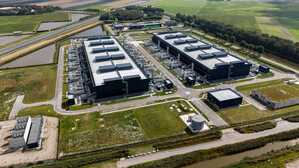
Data center energy demand is surging. Here’s how enterprises can meet sustainability goals through smarter colocation, cloud, and network infrastructure choices.
Beyond the Hype: A Practical Guide to Sustainable IT Infrastructure and Green Data Centers
For years, enterprise sustainability initiatives operated largely outside the day-to-day purview of the IT department. Today, the landscape has fundamentally shifted. Driven by board-level ESG mandates, heightened reporting requirements, and the explosive growth of power-intensive computing, CFOs and sustainability leads are looking directly at IT to quantify, and ultimately reduce, the organization’s technological footprint.
For IT directors, CIOs, and infrastructure leads, this presents a unique challenge. Most enterprises will never build a custom green data center from the ground up. Instead, their IT footprint is distributed across legacy server rooms, leased colocation spaces, vast cloud environments, and thousands of endpoints.
The most practical path to a sustainable IT infrastructure is not found in building new eco-facilities. It is found in the everyday infrastructure decisions IT teams already control: where workloads run, which facilities you colocate in, how much legacy hardware remains powered on, and how effectively you retire equipment. Fortunately, the operational mechanics of data center sustainability align almost perfectly with enterprise cost reduction.
The New Reality of Data Center Energy Consumption
The collision of corporate carbon targets and the rapid adoption of artificial intelligence has created a measurable tension within enterprise IT. Many organizations established ambitious carbon reduction targets before the AI boom, only to find their IT energy footprint expanding at an unprecedented rate.
The urgency behind data center sustainability is quantified by the International Energy Agency (IEA). According to the IEA’s April 2026 findings, data center electricity demand rose by 17% in 2025. During that same period, demand from AI-focused data centers jumped by a staggering 50%—both numbers drastically outpacing the 3% growth seen in overall global electricity demand.
Looking ahead, the IEA projects that global data center consumption will more than double to approximately 945 TWh by 2030, with artificial intelligence remaining the primary driver. A significant portion of this energy does not even go toward computing; cooling systems alone account for an estimated 30% to 55% of a data center’s total energy use.
However, efficiency is steadily improving. The IEA projects the global weighted average PUE (Power Usage Effectiveness) will fall from 1.41 to 1.29, a shift that is expected to save around 90 TWh of demand. For enterprise IT leaders, the goal is to align their own infrastructure strategies with this overarching push for efficiency.
Defining the "Green Data Center": Metrics Over Marketing
When evaluating providers for a sustainable IT infrastructure, it is critical to look past greenwashed marketing language like "eco-friendly" and focus on quantifiable metrics. A true green data center is a facility specifically designed and operated to minimize energy use, water consumption, and greenhouse gas emissions.
Understanding the core metrics of data center sustainability empowers IT teams to hold their vendors accountable and accurately report on their own Scope 3 emissions. Regulatory pressure is already increasing—such as the data center reporting rules outlined in the EU Energy Efficiency Directive—making verifiable metrics a business necessity.
- PUE (Power Usage Effectiveness): The most fundamental metric for data center energy consumption. PUE is calculated by dividing the total amount of energy used by the facility by the energy delivered specifically to the IT equipment. A PUE of 1.0 is the theoretical ideal, meaning 100% of the power goes to computing. As noted, the global weighted average is hovering around 1.41, though modern hyperscale facilities routinely achieve lower scores.
- WUE (Water Usage Effectiveness): Measures the ratio of water used for cooling and facility operations to the energy consumed by IT equipment. As water scarcity becomes a global concern, evaluating how a facility handles thermal management without massive water waste is critical.
- CUE (Carbon Usage Effectiveness): Measures the total carbon emissions produced relative to the energy consumed by IT equipment, providing a direct view into the facility's reliance on renewable energy versus fossil fuels.
5 Sustainability Decisions IT Already Controls
An enterprise does not need to own its facilities to dramatically improve data center sustainability. By optimizing how you buy, deploy, and retire technology, your organization can significantly reduce its footprint.
1. Choosing Efficient Colocation Facilities
Not all third-party facilities are created equal. When your enterprise outgrows on-premise server rooms, migrating to a modernized colocation environment offers an immediate sustainability upgrade, provided you choose the right partner. Through strategic communication technology sourcing, enterprises can mandate strict efficiency requirements in their RFPs.
Questions to ask prospective colocation providers:
-
What is your current and historical PUE, and how is it audited?
-
What specific cooling technologies (e.g., liquid cooling, hot/cold aisle containment, free cooling) are utilized?
-
What percentage of the facility's power is sourced from renewable energy?
-
Can you provide customized energy and emissions reporting for our specific footprint to support our corporate ESG disclosures?
To ensure your infrastructure lands in the most efficient environment, leverage comprehensive data center managed services that evaluate facilities on both performance metrics and sustainability standards.
2. Placing the Right Workloads in the Cloud
Migrating to the cloud is often touted as an automatic win for sustainability, but the reality is more nuanced. Hyperscale cloud providers operate highly optimized facilities that are generally far more efficient than a standard enterprise server room. However, an overprovisioned cloud environment running bloated, inefficient workloads can quickly erode those environmental benefits.
Achieving sustainability in the cloud requires meticulous right-sizing. Enterprises scaling energy-intensive AI capabilities must carefully consider where and how those workloads run. Properly architecting your deployment through robust cloud managed services ensures you only consume—and pay for—the compute power you actually need. (For a deeper dive into architecture types, read our guide on Navigating IaaS, PaaS, and SaaS).
3. Consolidating and Virtualizing Infrastructure
Physical server sprawl is a massive driver of unnecessary energy consumption. By undertaking a comprehensive communication technology consulting and design initiative, IT leaders can fundamentally rethink their network architecture.
Consolidating hardware through advanced virtualization allows a single physical server to run multiple virtual machines, dramatically increasing utilization rates. Higher utilization means less hardware drawing idle power and requiring environmental cooling.
4. Retiring Zombie Servers and Unused Circuits
One of the most insidious drains on both the corporate budget and the environment is "zombie" infrastructure—servers, storage arrays, and network circuits that remain powered on and actively drawing energy but are no longer performing useful work.
Locating and decommissioning these assets is a direct, measurable win for data center sustainability. This practice bridges the gap between ESG initiatives and technology expense management, proving that turning off unused legacy hardware is just as beneficial for the balance sheet as it is for the environment.
5. Responsible End-of-Life Disposal
Sustainability does not end when hardware is unplugged. The way an enterprise handles its retired assets dictates a significant portion of its environmental impact. E-waste is a critical global issue, and simply throwing away legacy servers or network switches is no longer acceptable.
Incorporating strict asset disposal protocols into your communication technology lifecycle optimization strategy ensures that equipment is securely wiped, refurbished, recycled, or responsibly disposed of, supporting the circular IT economy while maintaining total data security.
Where Cost Reduction and Data Center Sustainability Overlap
There is a persistent misconception that prioritizing a sustainable IT infrastructure inherently costs more. In reality, the foundational steps of IT sustainability—consolidation, decommissioning unused assets, and right-sizing cloud environments—are fundamentally cost-reduction strategies.
When you decommission a zombie server, you immediately eliminate the power cost to run it, the cooling cost to maintain its temperature, and the software licensing costs associated with its operating system. When you right-size a cloud deployment to eliminate idle compute instances, your monthly cloud spend drops alongside your carbon footprint. This powerful overlap is what allows IT leaders to easily secure CFO buy-in for modernization projects: efficiency is profitable.
How Advantage Turns Intent into Infrastructure
Transitioning from abstract sustainability goals to concrete infrastructure optimization requires visibility, strategy, and vendor leverage. Advantage serves as the partner that enables enterprises to make environmentally and financially sound IT decisions without sacrificing performance.
With access to a portfolio of over 800 global provider partners, Advantage helps organizations evaluate and source highly efficient colocation facilities, dedicated internet access (DIA), and broadband networks that meet strict operational and ESG criteria.
The foundation of both cost savings and sustainability is visibility. You cannot optimize what you cannot see. Through Command Center℠, enterprises gain an exhaustive, unified view of their entire inventory of circuits, contracts, and hardware assets. This single source of truth is the essential starting point for identifying waste, tracking down unused services, and planning intelligent consolidations.
Ready to align your IT infrastructure with your organization's financial and sustainability goals? Contact Advantage today to start optimizing your environment.
Frequently Asked Questions (FAQ)
What is a green data center? A green data center is a facility designed and operated to minimize energy use, water use, and greenhouse gas emissions. This is typically achieved through highly efficient cooling technologies, high-efficiency power systems, renewable energy sourcing, and strong performance across metrics like PUE and WUE.
What is a good PUE for a data center? Lower is always better, with a PUE of 1.0 being the theoretical ideal (indicating no power is wasted on cooling or overhead). The IEA notes the current global weighted average is approximately 1.41, with projections showing a drop to 1.29. Many modern hyperscale and leading colocation facilities operate well below the global average.
Is the cloud more sustainable than on-premise infrastructure? Often, yes. Hyperscale cloud facilities are typically far more efficient than small, aging enterprise server rooms. However, the environmental benefit depends heavily on right-sizing workloads to avoid wasted compute and the specific provider’s commitment to renewable energy sourcing.
How can enterprises reduce IT’s carbon footprint without owning a data center? Enterprises can drive significant reductions by choosing efficient colocation and cloud providers, consolidating and virtualizing their server environments, aggressively decommissioning idle hardware and unused network services, and managing hardware disposal responsibly.
Do AI workloads increase data center emissions? Yes. AI-focused data center electricity demand is growing much faster than overall global demand. Enterprises looking to scale their AI capabilities must actively factor energy consumption and computational efficiency into their deployment strategies to mitigate the environmental impact.
What should I ask a colocation provider about sustainability? When evaluating providers, ask for specific data on their PUE and WUE. Inquire about their use of advanced cooling technologies, the percentage of renewable energy powering the facility, and their ability to provide energy and emissions reporting that you can use for your own corporate disclosures.
Does sustainable IT cost more? Not necessarily. In fact, many sustainability initiatives generate immediate financial returns. Network consolidation, decommissioning unused assets, and right-sizing cloud environments directly reduce monthly operational costs while simultaneously lowering overall energy consumption.